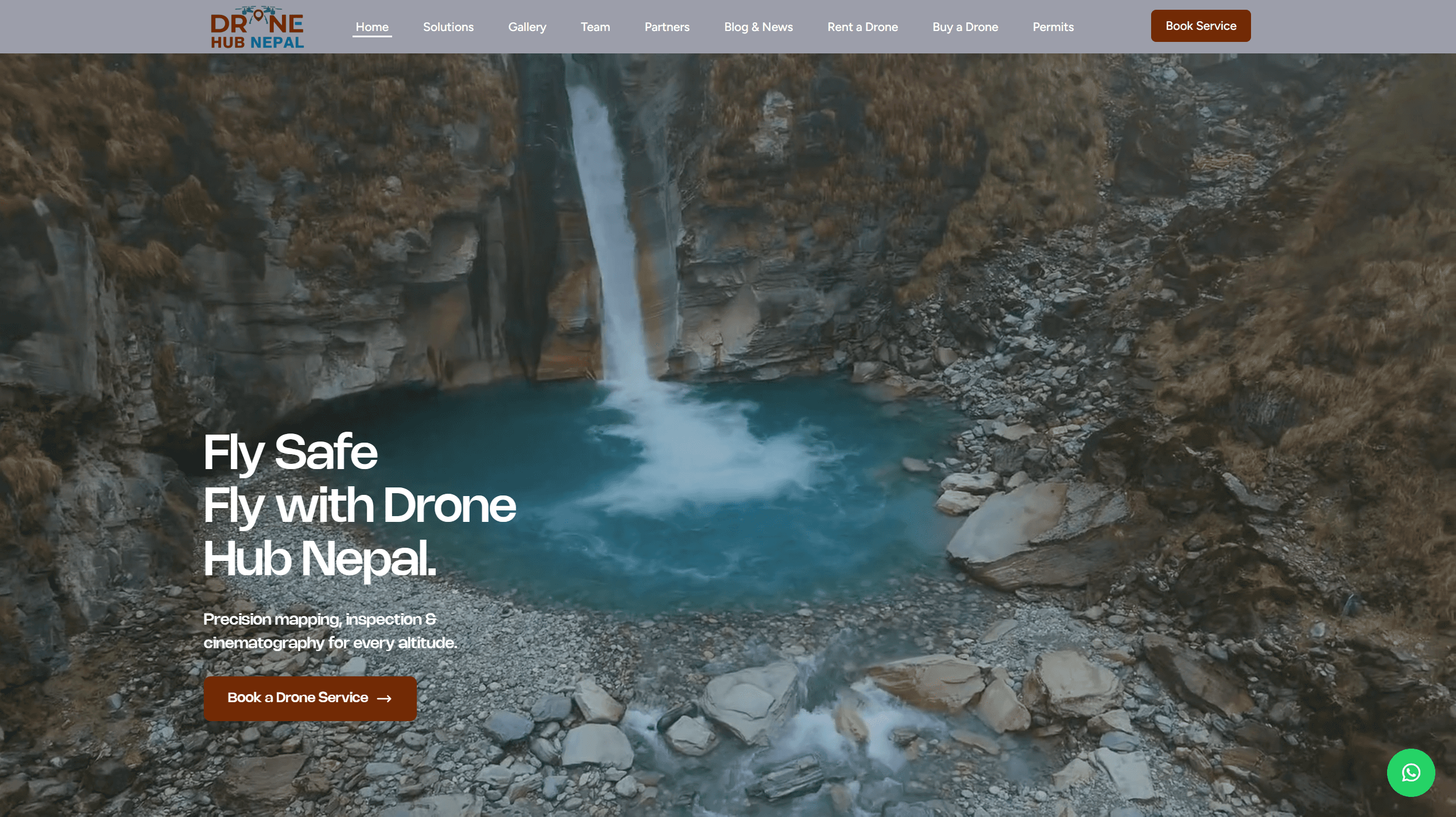
Drone Hub Nepal was operating three separate business lines — retail sales of commercial drones, specialized repair services, and pilot training programs — but each ran on disconnected systems. Customers browsing drones on the website couldn't book a training session without calling the office. Repair tracking happened in spreadsheets emailed between technicians. Inventory for retail, spare parts, and training equipment lived in three different databases that never talked to each other.
The existing website was a static WordPress brochure that listed products but didn't actually sell them. Every transaction required phone calls, WhatsApp messages, and manual invoicing. For a business positioning itself as Nepal's technology leader in the drone space, the digital experience was stuck in 2015.
The team was also struggling with a specific operational challenge: drone regulations in Nepal require licensed pilots for commercial operations, but customers buying drones often didn't realize they'd need training and certification before legal flight. This disconnect led to post-purchase confusion, regulatory compliance issues, and a missed opportunity to upsell training packages at the point of purchase.
The competitive landscape was shifting too. International e-commerce platforms were starting to ship drones directly to Nepal, undercutting local pricing. Drone Hub needed to compete on value beyond price — expertise, local support, training, and repair — but their digital presence didn't communicate any of that.
The brief: build a unified platform that makes buying, learning, and maintaining drones seamless, positions Drone Hub as the authoritative voice in Nepal's drone industry, and creates operational efficiency across three previously siloed business units.
We built a custom Next.js platform with three integrated modules — e-commerce, training management, and repair tracking — all running on a shared database with role-based access for customers, instructors, and technicians.
E-commerce: Smart Product Recommendations & Compliance Guidance
The product catalog isn't just a list of drones for sale. Each product page includes contextual education: "This drone requires a Part 107-equivalent license in Nepal to fly commercially. Book training now and get certified before your drone arrives."
At checkout, customers see intelligent upsells based on what they're buying:
- Buy a DJI Mavic 3? Suggested add-ons: spare batteries, ND filter set, hard case, and a "Beginner to Advanced Pilot" training package at a bundled discount.
- Buy a Phantom 4 RTK for surveying? Suggested add-on: "Mapping & Photogrammetry Certification" course.
The cart system bundles products + training + insurance into a single transaction but tracks them separately on the backend. When a customer checks out with a drone + training package, the training course automatically gets added to their student dashboard with instructions to book their first session.
Payment processing supports eSewa, Khalti, and bank transfers (still common in Nepal's B2B drone market). For high-value orders (enterprise drones often cost NPR 500,000+), customers can request a payment plan — the system generates an invoice schedule and tracks installments.
Training Management: Scheduling, Progress Tracking, Certification
Students log into their dashboard to see upcoming classes, completed modules, flight hours logged, and certification progress. Drone Hub's instructors have a separate instructor portal where they mark attendance, log flight hours, upload student performance notes, and issue certificates when someone completes a program.
The scheduling system handles multi-day courses with limited capacity. A "Commercial Drone Pilot Certification" course might run over 5 weekends with a max of 8 students per cohort. When someone books, the system checks real capacity (not just "available" but "instructor availability + drone availability + weather-appropriate dates") and prevents overbooking.
We integrated with Google Calendar so instructors can sync their teaching schedule, and students get automatic SMS reminders 24 hours before each session (via a Nepali SMS gateway).
Certificates are generated as PDFs with QR codes that link back to a public verification page — employers or regulatory bodies can scan the code and confirm that the certificate is real and active.
Repair Services: Intake, Diagnostics, Status Tracking
When a customer needs a repair, they submit a ticket through the website. They describe the issue, upload photos/videos of the damage, and ship or drop off the drone at Drone Hub's service center in Kathmandu.
Technicians receive the ticket in their dashboard, perform diagnostics, and update the status in real-time:
- "Received" → "Diagnosing" → "Parts ordered" → "Repairing" → "Testing" → "Ready for pickup"
Customers get email + SMS updates at each stage. If a repair requires expensive parts or extended labor, the system sends a quote for approval before proceeding — no surprise bills.
The parts inventory is shared across repair and retail. If a customer orders a spare propeller for their Mavic and it's out of stock in retail but available in the repair parts bin, the system flags it for the ops team to reallocate.
Unified Admin Dashboard: Cross-Business Intelligence
The Drone Hub team has a single admin dashboard that shows:
- E-commerce metrics: revenue, top-selling products, cart abandonment
- Training metrics: enrollment numbers, completion rates, instructor utilization
- Repair metrics: average turnaround time, most common repairs, parts inventory burn rate
This unified view revealed insights they couldn't see before. For example: customers who complete training spend 3.2x more on accessories over the following 12 months than customers who just buy a drone. This insight shifted their marketing strategy to prioritize training enrollment.
Tech Stack Summary:
- Frontend: Next.js 14, React, TypeScript, Tailwind CSS
- Backend: Node.js + Express API, MongoDB for flexible schema (products, courses, and repair tickets have very different data models)
- Payments: eSewa SDK, Khalti API, Stripe for international orders
- SMS: Sparrow SMS (Nepali gateway)
- Storage: AWS S3 for product images, repair photos, training certificates
- Hosting: DigitalOcean (Kathmandu region for low latency)
SEO & Content Strategy
We built a blog and resource center directly into the platform. Drone Hub publishes guides like "Drone Laws in Nepal: Complete 2026 Compliance Guide" and "Best Drones for Surveying in Himalayan Terrain." These long-form articles rank for high-intent queries and funnel organic traffic to product and training pages.
Every product page has detailed specs, use-case descriptions, and FAQs. This wasn't just good UX — it also made the site a resource that outranks generic e-commerce platforms for queries like "best drone for agriculture Nepal" or "survey drone price Kathmandu."
The unified platform launched in March 2025 after 14 weeks of development, with a phased rollout (e-commerce first, training 2 weeks later, repair services 4 weeks later).
E-commerce Revenue: +213% in First 6 Months
Moving from phone-order-only to a functional online store immediately expanded their addressable market. Customers outside Kathmandu (previously underserved) now account for 34% of total sales. Average order value increased 41% thanks to smart bundling and upsells.
Training Enrollment: +156%
Before the platform, training was marketed through word-of-mouth and manual outreach. The integrated enrollment system (especially the checkout upsells) tripled monthly training signups. Revenue from training programs went from a side business to 28% of total revenue.
Repair Service Efficiency: -60% Turnaround Time
The ticketing system and parts inventory integration cut average repair time from 12 days to 4.5 days. Customer satisfaction scores for repair services jumped from 3.2/5 to 4.6/5 — mostly because of transparency ("I could see my repair status update in real-time instead of calling every day").
Customer Retention: +89%
Customers who bought through the platform were significantly more likely to return. The student dashboard, repair history, and personalized recommendations created stickiness that the old system couldn't.
Operational Efficiency: Team Handles 2.8x Volume
Drone Hub's operations team stayed at 4 people but now handles 2.8x the transaction volume. Automated workflows (order confirmations, training reminders, repair status updates) eliminated hundreds of hours of manual communication.
Organic Traffic: +127% Year-Over-Year
The SEO-optimized product pages and blog content drove steady organic growth. Drone Hub now ranks #1 in Nepal for "buy drone Kathmandu," "drone training Nepal," and "DJI repair Nepal."
The platform has processed NPR 18M+ in sales, enrolled 380+ students in certification programs, and completed 540+ repair jobs since launch.