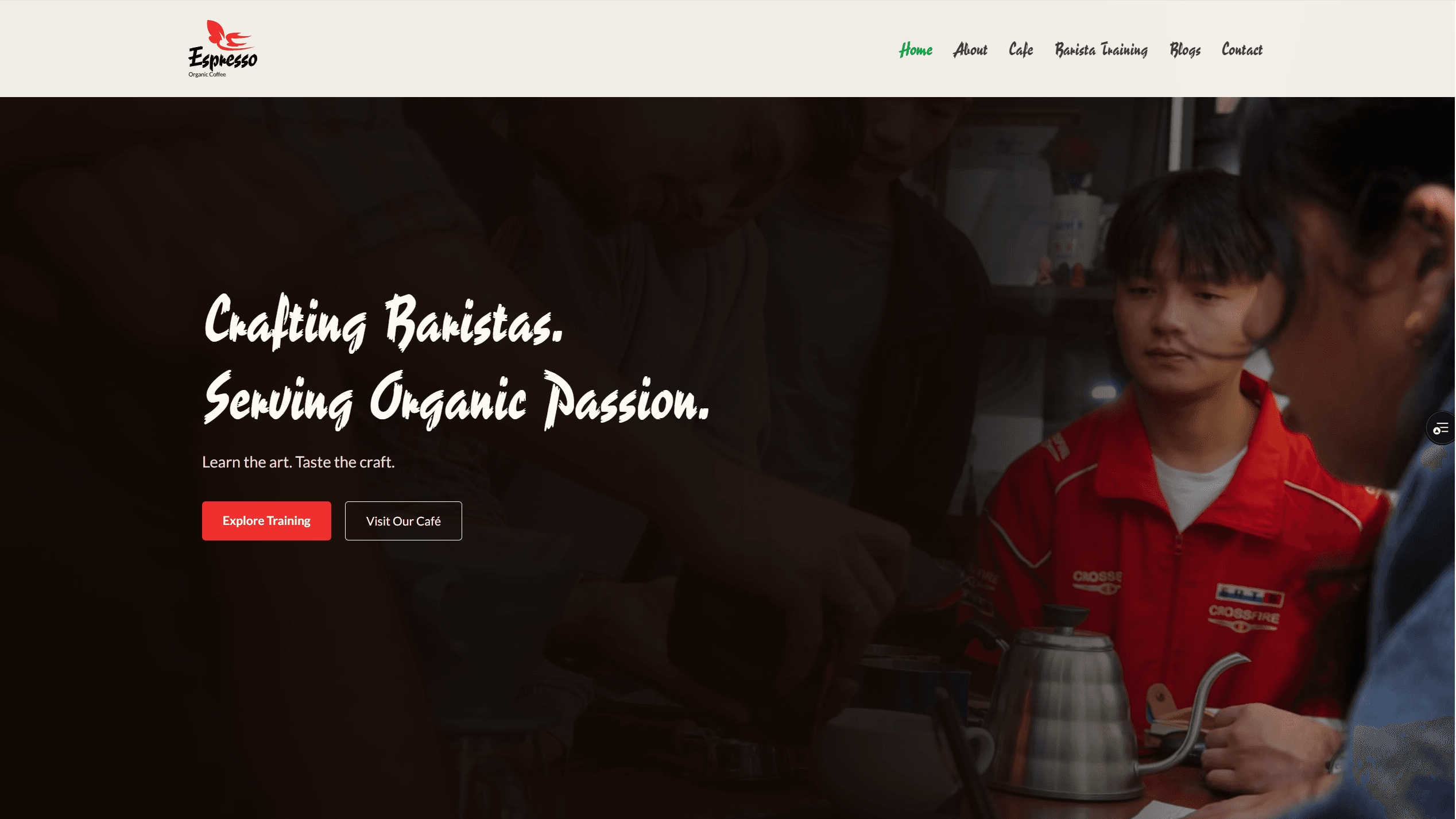
Brewing Digital Success for Nepal's Premium Coffee Brand
A premium coffee brand website featuring organic coffee products and specialized barista training programs, built for conversion and brand storytelling.
Espresso Organic Coffee had built a loyal following in Kathmandu's specialty coffee scene through their cafe and wholesale partnerships, but their digital presence didn't match the quality of their product. The existing website was a basic WordPress template with static product listings, no functioning shopping cart, and zero integration with their actual business operations.
Every online order came through WhatsApp or phone calls. A customer would see a product on the website, screenshot it, send it via WhatsApp, wait for a reply with pricing and availability, then coordinate payment and delivery manually. For a brand positioning itself as Nepal's premium organic coffee roaster, this friction-filled buying experience was leaving money on the table.
The bigger missed opportunity was their barista training program. Espresso runs professional barista courses that train cafe staff across Kathmandu, but this entire revenue stream was invisible online. Prospective students had no way to see course schedules, curriculum details, or book spots without visiting the cafe in person or calling during business hours. They were losing enrollments to competitors with functioning booking systems.
The brand storytelling was also weak. Espresso sources beans directly from organic farms in Gulmi and Palpa, processes them in small batches, and has a genuine farm-to-cup story that differentiates them in a market flooded with commodity coffee. But the website showed none of this — just product photos on white backgrounds with prices.
The team also needed better operational control. They were managing inventory in a separate spreadsheet, processing orders in WhatsApp chat threads, and manually updating availability. As online demand grew, this system was starting to crack.
The brief: build an e-commerce platform that sells coffee as well as the brand sells it in-person, make the barista training program visible and bookable online, and tell the farm-to-cup story in a way that justifies premium pricing.
We built a custom Next.js platform that combines e-commerce, training enrollment, and brand storytelling into a cohesive digital experience that feels like Espresso's physical spaces — warm, premium, and deeply rooted in craft.
E-commerce: Story-Driven Product Pages
Every coffee product page is designed to sell not just beans, but the story behind them. Instead of generic descriptions, each product includes:
Origin Story: "Grown by the Thapa family farm in Gulmi district at 1,600m elevation. Harvested November 2025, wet-processed, sun-dried for 14 days."
Brewing Guide: Recommended brew methods, grind size, and ratio depending on whether the customer is making espresso, pour-over, or French press
Roast Profile: Visual timeline showing the roasting journey from green bean to final roast level
This level of detail isn't just marketing — it educates customers and justifies the price. A 250g bag of Espresso's single-origin costs NPR 1,200-1,500, roughly double the supermarket price. The product pages explain why.
The shopping experience is frictionless:
Add to cart, apply discount codes, choose delivery (Kathmandu same-day or nationwide 2-3 days)
Pay via eSewa, Khalti, or bank transfer
Get order confirmation via SMS with tracking
Receive brewing tips via email 24 hours after delivery
We integrated with Pathao's delivery API for Kathmandu orders. Customers can track their coffee in real-time from roastery to doorstep.
Subscription Model: Auto-Ship for Regulars
Many of Espresso's customers are daily drinkers who buy the same coffee every 2-3 weeks. We built a subscription system that lets them set up auto-delivery:
Choose coffee, quantity, and delivery frequency (weekly, bi-weekly, monthly)
Get 15% off subscription orders
Skip, pause, or swap coffees anytime from their account dashboard
Automatic payment on delivery date, SMS notification 2 days before shipment
Subscriptions now account for 38% of revenue and have dramatically improved customer lifetime value.
Barista Training: Course Management & Enrollment
The training section is a mini-LMS (Learning Management System). Espresso offers three certification tracks:
Home Barista Basics (1-day weekend course, NPR 3,500)
Professional Barista Certification (5-day intensive, NPR 18,000)
Coffee Business Masterclass (for cafe owners, 3 days, NPR 25,000)
Each course page shows:
Curriculum breakdown (what you'll learn each day)
Instructor bios with photos and credentials
Upcoming dates with real-time capacity ("4 spots left")
Student testimonials and graduate showcase
"Book Now" button that checks availability and processes payment
After booking, students get:
Confirmation email with pre-course prep materials
Access to a student portal with digital resources (brew ratio charts, troubleshooting guides, video tutorials)
Calendar invite with location details
Post-course certificate (PDF download, signed by the head instructor)
The admin dashboard lets Espresso's training coordinator manage courses, view enrollments, mark attendance, and track completion rates.
Brand Storytelling: The Farm-to-Cup Journey
We built an immersive "Our Story" section with:
Interactive Map: Clickable map of Nepal showing partner farms in Gulmi, Palpa, and Ilam. Click a region to see farm photos, farmer profiles, and elevation/climate details.
Roasting Process: Step-by-step visual guide to how green beans become finished coffee, with photos from Espresso's roastery.
Sustainability Commitment: Details on organic certification, direct-trade partnerships, and compostable packaging.
Meet the Team: Profiles of the roasters, trainers, and baristas who make Espresso what it is.
This wasn't just content marketing — it gave first-time visitors a reason to pay premium prices and choose Espresso over cheaper alternatives.
Inventory & Operations: Real-Time Sync
The platform integrates with Espresso's inventory system (a simple Google Sheet they were already using). Every time an order is placed:
Inventory decrements automatically
If stock drops below threshold, the team gets an alert
Out-of-stock products show "Roasting soon — notify me when available"
When a new batch is roasted and logged in the sheet, products auto-restock on the website. This eliminated the "order taken, but we're actually out" problem that was damaging trust.
These guides rank for high-intent queries ("how to brew coffee Nepal," "barista training Kathmandu") and funnel organic traffic to product and course pages. Every blog post ends with relevant product recommendations or training course CTAs.
The new platform launched in June 2025 after 10 weeks of development, replacing the old WordPress site and WhatsApp-based ordering system.
Online Revenue: +284% in First Year
Moving from manual WhatsApp orders to a functioning e-commerce platform immediately unlocked growth. Online sales went from 12% of total revenue to 41%. Average order value increased 33% thanks to upselling (customers buying equipment alongside beans) and subscriptions.
Barista Training Enrollment: +197%
Before the platform, training courses filled slowly through word-of-mouth. The online booking system and SEO-optimized course pages tripled enrollment. The Professional Barista Certification course now fills within 48 hours of being posted, and they've added a waitlist feature to capture overflow demand.
Training revenue grew from a side project (NPR 180,000/year) to a significant business line (NPR 540,000/year).
Subscription Revenue: 38% of Total Online Sales
The auto-ship subscription model created predictable recurring revenue. 320+ active subscribers as of March 2026, generating consistent monthly cashflow and improving inventory planning (they know roughly how much to roast each week).
Customer Acquisition Cost: -52%
Paid ads and influencer partnerships now convert at 3.1x the previous rate because the landing experience is optimized. The old site converted at 0.8% (80 out of 10,000 visitors bought); the new site converts at 2.5%.
Operational Efficiency: Zero Manual Order Processing
The team eliminated all WhatsApp order coordination. Orders flow automatically from website → kitchen printer → packing → delivery partner. The operations lead went from spending 15 hours/week on order coordination to zero.
Organic Traffic: +156% Year-Over-Year
The blog content and SEO-optimized product pages drove steady organic growth. Espresso now ranks #1 in Nepal for "buy organic coffee Nepal," "barista training Kathmandu," and "single origin coffee Kathmandu."
Brand Perception: Positioned as Nepal's Premium Coffee Brand
Customer surveys show that the website significantly improved brand perception. The farm-to-cup storytelling and professional presentation justified premium pricing and differentiated Espresso from commodity coffee sellers.